

DSH Codex Subscription
☆ 99Use your ChatGPT / Codex subscription with DeepSeek Harness via OAuth, with model access, usage quotas, search, and image generation — no API key or Codex CLI required.
Get this plugin
Review the source, then continue to the publisher.
dsh plugin --profile web add dsh-codex-subscriptionAbout this plugin
Source snapshot 8/18/2026DSH Codex Subscription


简体中文
A removable DeepSeek Harness bundle that exposes a user's ChatGPT / Codex subscription as a native DSH model route. It adds host-managed OAuth, subscription quota display, and cache-aware transport telemetry without replacing DSH's shell or silently falling back to a paid API.
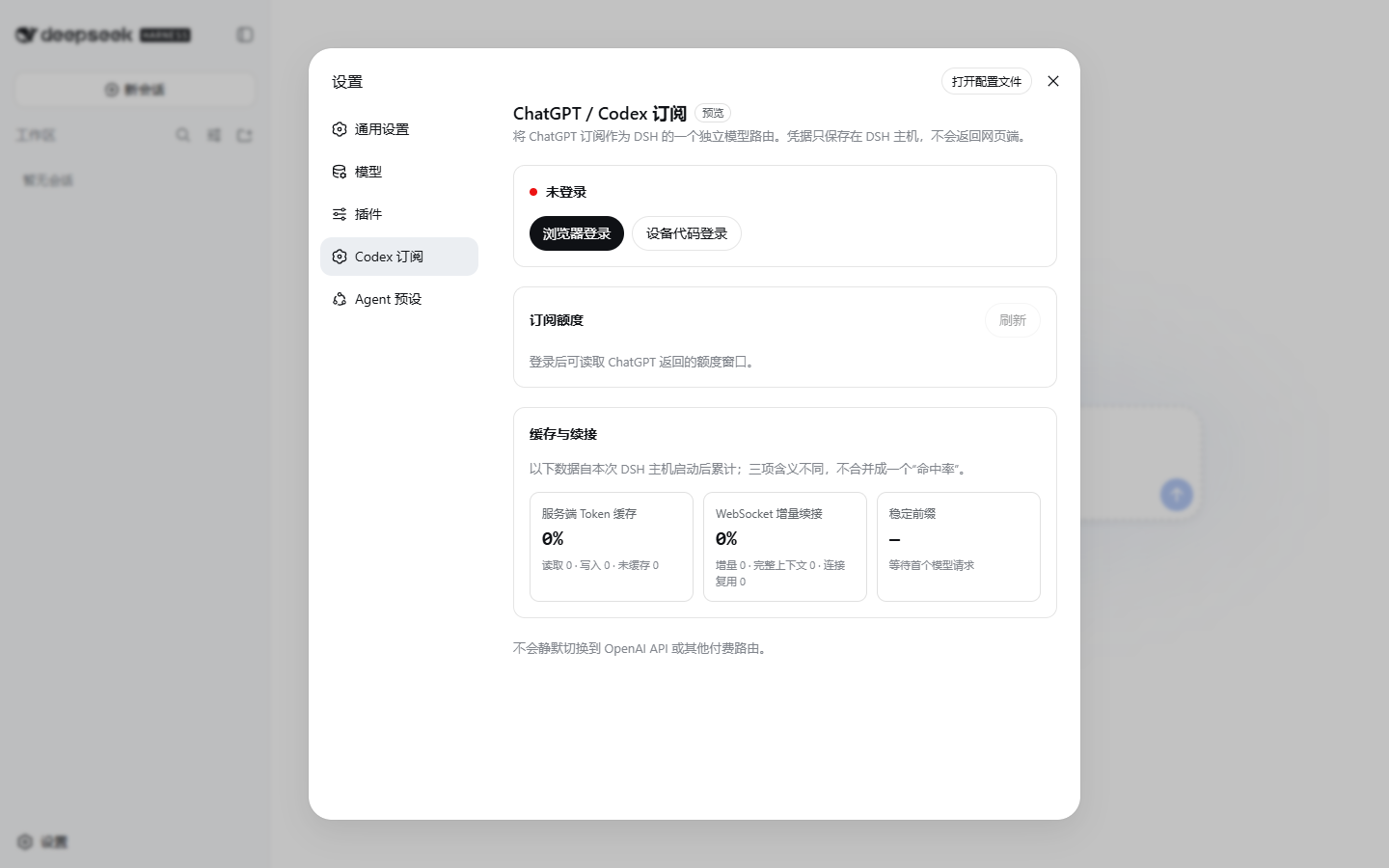
Community project, not affiliated with or endorsed by DeepSeek or OpenAI. DeepSeek Harness is currently a developer preview, and the ChatGPT Codex backend is not the public OpenAI API. Either side may change incompatibly.
What is different
- Native DSH provider route. The model stays in DSH's existing picker, conversation, tools, and permission system. The plugin does not create a second application shell.
- Host-only OAuth lifecycle. Browser and device-code sign-in are handled on the DSH host. Access tokens, refresh tokens, and account identifiers are never returned to the settings client.
- Cache-aware Codex transport. Requests use a stable per-session
prompt_cache_key,store: false, encrypted reasoning replay, and automatic WebSocket continuation throughprevious_response_idwhen the exact predecessor is available. - Three honest cache signals. The settings page keeps server-reported cached tokens, WebSocket delta continuation, and model-visible prefix stability separate. It does not turn them into a misleading synthetic score.
- No paid fallback. If the subscription route is unavailable, the turn fails visibly. The bundle never switches to an OpenAI API key or another billable provider behind the user's back.
- Removable composition. The package contributes two additive Cordis rows. Removing the bundle removes its host route and settings section without patching DSH source.
Install
Requirements:
- Node.js
^22.19.0or>=24.0.0 - DeepSeek Harness
0.1.0-rc.6(the exact compatibility baseline for this release) - a ChatGPT account whose subscription currently has Codex access
Install the tagged, prebuilt GitHub release into the Web profile:
dsh plugin --profile web add github:WSL043/dsh-codex-subscription#v0.1.1
dsh --profile web --dump-config
dsh web
The config dump should include wsl043-codex-boundary and wsl043-codex-subscription. Open Settings → Codex subscription, sign in, then choose a Codex model through DSH's normal model picker.
For local development, install the checkout directly:
dsh plugin --profile web add ./dsh-codex-subscription
This repository commits its tested lib/ output, so a GitHub installation does not need permission to execute a package prepare script. Codex transport is an exact peer of DSH's existing pi-ai adapter rather than a second copied provider stack.
Remove
dsh plugin --profile web remove @wsl043/dsh-codex-subscription
Sign out first if you also want the plugin to remove its stored OAuth credential. Removing a package does not silently delete credentials from an already unavailable plugin.
Cache behavior
The plugin preserves the two reuse mechanisms available in the current Codex transport:
- The request carries a stable DSH session identifier as
prompt_cache_key. Server usage is projected as exact uncached-input, cache-read, cache-write, and output token counts when the provider reports them. - With the automatic WebSocket transport, the first request sends full context. A compatible next request on the same live connection may send only the delta plus
previous_response_id. A reconnect, changed predecessor, or transport failure sends full context or falls back to SSE.
The plugin also fingerprints only the stable model-visible prefix—provider/model, system instructions, and tool schemas—to explain avoidable prefix churn without storing prompts. It deliberately does not inject login or quota tools into the model's tool catalog.
This is not a promise of a 98% cache hit rate. Task shape, new tool output, context compaction, model or tool changes, connection lifetime, and provider policy all affect reuse. The subscription backend exposes no public contract for explicit cache TTL or cache breakpoints, so this plugin does not claim to control either. See Cache architecture.
Security and privacy boundary
- OAuth credentials use DSH's credential service as one opaque host-side value.
- Account RPC is registered as loopback-only and returns redacted status, quota, and aggregate telemetry.
- Only
https://auth.openai.comURLs can be returned or opened by the login flow. - Cache telemetry is process-local, bounded, content-free, and resets when the DSH host restarts.
- No API-key fallback, cross-provider retry, prompt logging, or browser storage is added.
The plugin itself executes with DSH host privileges. Review and pin the source you install. Never post OAuth tokens, callback URLs containing codes, or account identifiers in a public issue. See SECURITY.md.
Known limitations
- Both DSH and this bundle are developer preview software.
- The ChatGPT Codex OAuth and quota endpoints can change independently of the public OpenAI API.
- Quota values are shown exactly as the provider reports them; they are not billing guarantees.
- Cache telemetry begins at process start and is diagnostic, not accounting data.
- This plugin integrates a subscription route; it does not convert a ChatGPT subscription into an OpenAI API key.
Development
pnpm install --frozen-lockfile
pnpm test
pnpm run build
pnpm pack --pack-destination .artifacts
The test suite covers OAuth redaction and serialization, login URL boundaries, loopback RPC registration, provider/fallback policy, actual Codex request fields, cached-token mapping, quota parsing, cache telemetry, client composition, and release contents. Networked model calls are intentionally not part of the default test suite.
License
MIT. Third-party packages retain their own licenses; see THIRD_PARTY_NOTICES.md.
Related DeepSeek Harness Plugins
Browse UI & Design →
Agent skill for beautiful, verifiable architecture, workflow, sequence, data-flow, and lifecycle diagrams—self-contained HTML with motion and crisp export.

The first vision plugin for DeepSeek Harness, and the vision bridge for every text-only coding agent. Paste an image, get structured JSON evidence (OCR, layout, semantics). | 全网最强 DeepSeek Harness 外挂视觉插件,为 DeepSeek、GLM 等纯文本模型外挂视觉能力,粘贴图片即得结构化 JSON 证据(OCR、版面、语义)。

Eyes for text-only DeepSeek Harness agents: built-in free vision chain (no key) + pixel-level vision tools (Q&A, grounding, crop, pixel diff, colors, OCR, SVG trace, cutout, screenshots). One-command install, no Python, image turns work like ordinary tool-calling turns.

DeepSeek Harness 可编辑设计系统:AI 生成、可视化编辑、模板市场与 PPT|Native Design & PPT Studio for DeepSeek Harness.