

DSH Fail Logger
☆ 9DeepSeek Harness(DSH)插件:自动记录所有执行模式(原生工具 / PTC run_code / 代码内嵌工具调用)的工具失败错因,去重、计数、确定性排序后沉淀进 skill 的机器维护实录区段——让 Agent 越用越少错。
Get this plugin
Review the source, then continue to the publisher.
dsh plugin --profile web add dsh-fail-loggerAbout this plugin
Source snapshot 8/18/2026中文 | English
dsh-fail-logger



An all-mode tool failure recorder for DeepSeek Harness: whether the agent runs in native mode or PTC (Code Mode), any tool failure is automatically written into the machine-maintained section of a skill — normalized-dedup, counted, deterministically ranked, TTL-pruned, and redacted — so the next session's model sees the most common failure causes when it loads the skill. Fail less over time.
Coverage matrix & trigger conditions
| Execution mode | Failure source | Recorded as (kind / message) |
|---|---|---|
| Native tools (read/grep/write and third-party plugin tools…) | tool/call + tool/result (tool-result block isError=true) | tool / [read] ENOENT: no such file … |
PTC run_code failures | tool/result (isError=true) | official kind (exception/timeout/abort/…) / raw message |
Nested tool calls inside a code program (tools.* throwing) | tool/code-dispatch (isError=true) | tool / [bash] exit code: 1 |
Trigger condition: a failure is recorded only when the tool result is marked
isError: true. A non-zero shell exit code does NOT trigger recording (e.g.exit 1is presented as plain text[exit code: 1], not an error) — only genuinely thrown tool calls (read on a missing file, grep failure, run_code crash, …) enter the log.
The observation point is the session log (session/event) — the exact same hook the official telemetry plugin uses. Pure observer: no service injection, no runtime wrapping, can never affect execution.
| Session failures (captured automatically) | Skill auto-log section |
|---|---|
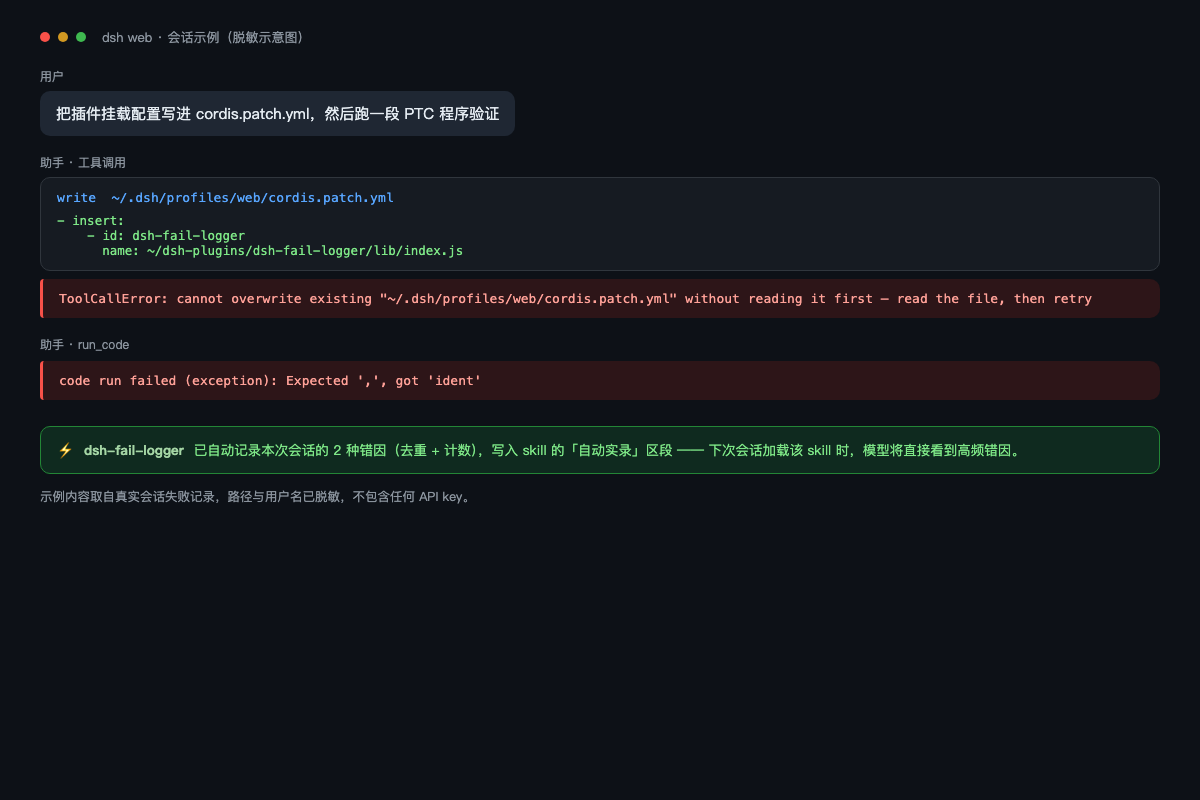 | 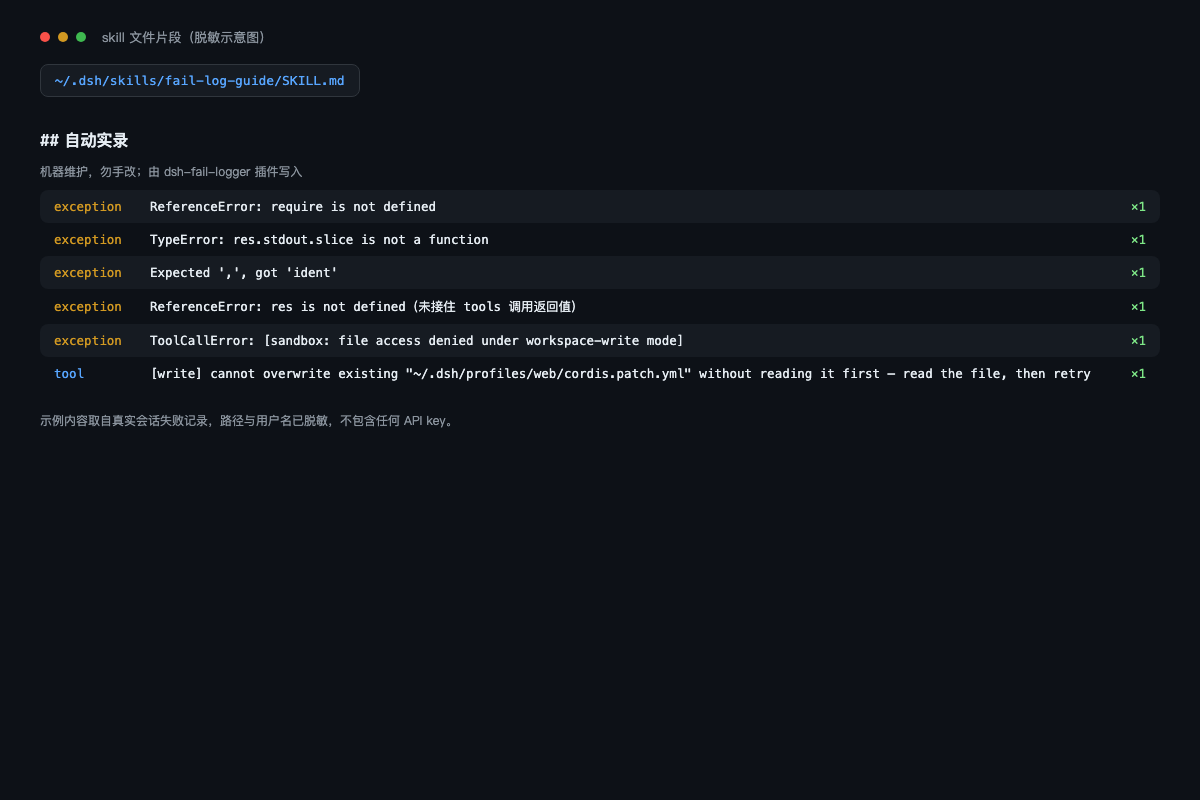 |
Legend — left: tool failures in a session are captured automatically; right: the causes accumulate in the skill's auto-log section (deduplicated, counted, ranked by frequency).
Section preview
<!-- FAIL-LOG:BEGIN -->
## 自动实录(机器维护,勿手改;由 dsh-fail-logger v0.4.0 维护)

近 7 天失败: 0→0→0→1→0→2→0(今天→6 天前)

### 权限与沙盒
- [tool] [bash] EPERM: operation not permitted, open '/Users/me/.dsh/x' — ×3(最近 2026-08-14 10:20)|命令: `rm -rf /x`|💡 检查沙盒权限,或用被允许的操作重试

### 文件系统
- [tool] [read] ENOENT: no such file or directory — ×2(最近 2026-08-14 10:19)|💡 先确认路径存在再操作
<!-- FAIL-LOG:END -->
Install
# npm (recommended)
dsh plugin --profile web add dsh-fail-logger

# or pin to an exact version
dsh plugin --profile web add dsh-fail-logger@0.4.1

# or GitHub release tag (no npm registry dependency; auditability & rollback)
dsh plugin --profile web add "github:Areium/dsh-fail-logger#v0.4.1"

# or manually: merge cordis.patch.yml's insert entry into ~/.dsh/profiles/web/cordis.patch.yml
Restart dsh --profile web. Zero configuration, works out of the box. Same for headless: dsh plugin --profile headless add ….
Config (patch entry config:, all optional)
- insert:
    - id: dsh-fail-logger
      name: 'dsh-fail-logger'
      config:
        logDir: ~/.dsh/skills/fail-log-guide   # target skill directory
        maxEntries: 10     # max rows per category
        maxMsg: 200        # chars kept per message
        marker: FAIL-LOG   # section marker id ([A-Za-z0-9-])
        flushMs: 300       # burst-coalescing debounce window
        ttlDays: 30        # drop entries with no new occurrence for N days (0 = keep forever)
        redact: []         # extra redaction regexes (string array)
        ignore: []         # ignore list (tool-name/message regexes, e.g. ['^read
How it works
- Listens to
session/event, consuming three event kinds:tool/call(callId→{tool name, args} map),tool/result(parses the real rc.6 shape:message.content[].type === 'tool-result'block'sisError/toolCallId; legacy shape still supported),tool/code-dispatch(recorded only when isError). A one-time visible warning fires on unexpected shapes. - Normalized dedup: paths (quoted / drive-letter / absolute →
<path>) and long numbers (→<n>) are normalized before the SHA1 key — the same EPERM on/Users/a/xand/Users/b/ymerges into one entry;data.error.code(e.g.SEARCH_FAILED) joins the key when present. - Redaction & sanitization: defaults cover
sk-…keys,Bearer/Basicauth,-u user:passand inline URL credentials,api_key/token/secret/password=assignments, credential file paths, and private IPs; extend viaconfig.redact. Control chars stripped, markdown pipes/backticks escaped (anti inline injection). - Cross-process lock-merge: flush takes an exclusive lock (
wx, stale >5s recycled) and re-reads + merges the on-disk state before writing — web/headless concurrency no longer loses increments; failed writes keep dirty and retry after 2s. - Trend & TTL: per-day counters render a "last 7 days" trend line; entries with no new occurrence for
ttlDaysare archived. - Categorized rendering: grouped under filesystem / permissions & sandbox / timeout & budget / network & remote / other, with rule-based 💡 suggestions; deterministic total-order ranking (count↓ → last↓ → first↓ → hash↑); state pruned beyond
maxEntries×5. - All writes are atomic (tmp + rename); corrupt state is backed up as
.bak-<timestamp>before reset; a visible startup line logs activation and probes logDir writability.
Known limitations
- Only failures that reach the session log: catastrophic process death during tool execution is out of scope.
- Corrupt state is backed up: an unparseable
.failures.jsonis renamed to.failures.json.bak-<timestamp>before reset. - Non-zero exit codes are not recorded: see the trigger conditions (DSH semantics, not a plugin bug).
- Dedup is heuristic: keyed on the normalized first 1-3 lines of text; the same root cause with different wording may split, and different causes with identical wording may merge — acceptable, but be aware.
- Display keeps the original text: path/username normalization affects the dedup key only; messages display the original (except redaction rules). For stricter privacy, configure
config.redactper workspace.
Community
- npm: dsh-fail-logger (
dsh plugin --profile web add dsh-fail-logger) - GitHub topic: dsh-plugin (
deepseek-harness/dsh/skill/fail-logger) - Curated list: awesome-dsh-plugin
How it differs from similar community plugins
distill(conversation distillation) anddsh-skillport(skill library import): proactive skill generation/import; this plugin passively records run facts. Complementary.dsh-trace/dsh-telemetry-redactor(telemetry export to external platforms): external observability; this plugin targets local skill self-healing with no external channel.dsh-notify(error notifications): alerts only; this plugin accumulates a searchable long-term memory.
Design boundaries (explicit non-goals)
- No LLM summarization: calling a model per failure adds cost, network and external dependencies, breaking the pure-observer positioning; rule-based suggestions suffice.
- No external export: keeps a distinct niche from dsh-trace/telemetry.
- No proactive fixes: record only, never auto-change behavior — avoids amplifying risk.
- Roadmap: per-workspace failure memory isolation (
logDirtemplate /@workspacetags on entries).
Development & tests
npm run check   # node --check lib/index.js
npm test        # 14 suites: real event-shape parsing/legacy compat/normalized dedup/redaction/pruning/TTL/corruption recovery/marker healing/debounce/dispose/lock contention/ignore list/log replay
Real-log replay (against fake-green tests): FAIL_LOG_REPLAY=<session.jsonl> npm test feeds real session events into the same handler. Session logs live at ~/.dsh/sessions/**/session.jsonl (run zstd -d first if compressed). tests/fixtures/session.jsonl is a real-shape fixture run by CI on every push.
Post-install smoke test:
dsh --profile headless "use the read tool on a file that does not exist"   # trigger a guaranteed failure
tail -20 ~/.dsh/skills/fail-log-guide/SKILL.md                              # FAIL-LOG section with the cause should appear
License
MIT, 'deliberate|noise'])
## How it works

- Listens to `session/event`, consuming three event kinds: `tool/call` (callId→{tool name, args} map), `tool/result` (parses the real rc.6 shape: `message.content[].type === 'tool-result'` block's `isError`/`toolCallId`; legacy shape still supported), `tool/code-dispatch` (recorded only when isError). A one-time visible warning fires on unexpected shapes.
- **Normalized dedup**: paths (quoted / drive-letter / absolute → `<path>`) and long numbers (→ `<n>`) are normalized before the SHA1 key — the same EPERM on `/Users/a/x` and `/Users/b/y` merges into one entry; `data.error.code` (e.g. `SEARCH_FAILED`) joins the key when present.
- **Redaction & sanitization**: defaults cover `sk-…` keys, `Bearer` tokens, `api_key/token/secret/password=` assignments, and credential file paths; extend via `config.redact`. Control chars stripped, markdown table pipes escaped (anti prompt-injection).
- **Cross-process lock-merge**: flush takes an exclusive lock (`wx`, stale >5s recycled) and re-reads + merges the on-disk state before writing — web/headless concurrency no longer loses increments; failed writes keep dirty and retry after 2s.
- **Trend & TTL**: per-day counters render a "last 7 days" trend line; entries with no new occurrence for `ttlDays` are archived.
- **Categorized rendering**: grouped under filesystem / permissions & sandbox / timeout & budget / network & remote / other, with rule-based 💡 suggestions; deterministic total-order ranking (count↓ → last↓ → first↓ → hash↑); state pruned beyond `maxEntries×5`.
- All writes are atomic (tmp + rename); corrupt state is backed up as `.bak-<timestamp>` before reset; a visible startup line logs activation and probes logDir writability.

## Known limitations

- **Only failures that reach the session log**: catastrophic process death during tool execution is out of scope.
- **Corrupt state is backed up**: an unparseable `.failures.json` is renamed to `.failures.json.bak-<timestamp>` before reset.
- **Non-zero exit codes are not recorded**: see the trigger conditions (DSH semantics, not a plugin bug).

## How it differs from similar community plugins

- `distill` (conversation distillation) and `dsh-skillport` (skill library import): *proactive* skill generation/import; this plugin *passively* records run facts. Complementary.
- `dsh-trace` / `dsh-telemetry-redactor` (telemetry export to external platforms): external observability; this plugin targets *local skill self-healing* with no external channel.
- `dsh-notify` (error notifications): alerts only; this plugin accumulates a searchable long-term memory.

## Design boundaries (explicit non-goals)

- **No LLM summarization**: calling a model per failure adds cost, network and external dependencies, breaking the pure-observer positioning; rule-based suggestions suffice.
- **No external export**: keeps a distinct niche from dsh-trace/telemetry.
- **No proactive fixes**: record only, never auto-change behavior — avoids amplifying risk.
- Roadmap: per-workspace failure memory isolation (`logDir` template / `@workspace` tags on entries).

## Development & tests

```sh
npm run check   # node --check lib/index.js
npm test        # 12 suites: real event-shape parsing/legacy compat/normalized dedup/redaction/pruning/TTL/corruption recovery/marker healing/debounce/dispose/lock retry/log replay
Real-log replay (against fake-green tests): FAIL_LOG_REPLAY=<session.jsonl> npm test feeds real session events into the same handler. Session logs live at ~/.dsh/sessions/**/session.jsonl (run zstd -d first if compressed). tests/fixtures/session.jsonl is a real-shape fixture run by CI on every push.
Post-install smoke test:
dsh --profile headless "use the read tool on a file that does not exist"   # trigger a guaranteed failure
tail -20 ~/.dsh/skills/fail-log-guide/SKILL.md                              # FAIL-LOG section with the cause should appear
License
MIT
Related DeepSeek Harness Plugins
Browse Automation →
DSHDesktop:DeepSeek Harness Desktop / DeepSeek Harness 桌面版

Agent OS: the agent gets smarter on its own. We just hold the line: Interview-gated, staged evaluation, budgeted evolution loop. MCP server, 14 runtimes: Claude Code, Codex CLI, Gemini CLI, OpenCode, Copilot, Kiro and more.

开放的侧边栏底座,支持三方拓展注册新侧边栏页面。内置文件渲染编辑/终端/侧边对话/Git/子代理页面 | Open sidebar foundation, supports third-party extensions to register new sidebar pages. Built-in file rendering/editing, terminal, side chat, Git, and sub-agent pages.

DSH 官方公众号收录的 TUI 补位插件:鲸鱼顶栏/实时状态/流式思考/双击 Esc 回滚/上下文进度+TPS。npm 一键装。 DSH official WeChat featured TUI plugin — whale bar, live status, streaming thoughts, double-Esc rollback, context bar + TPS. npm one-click.